
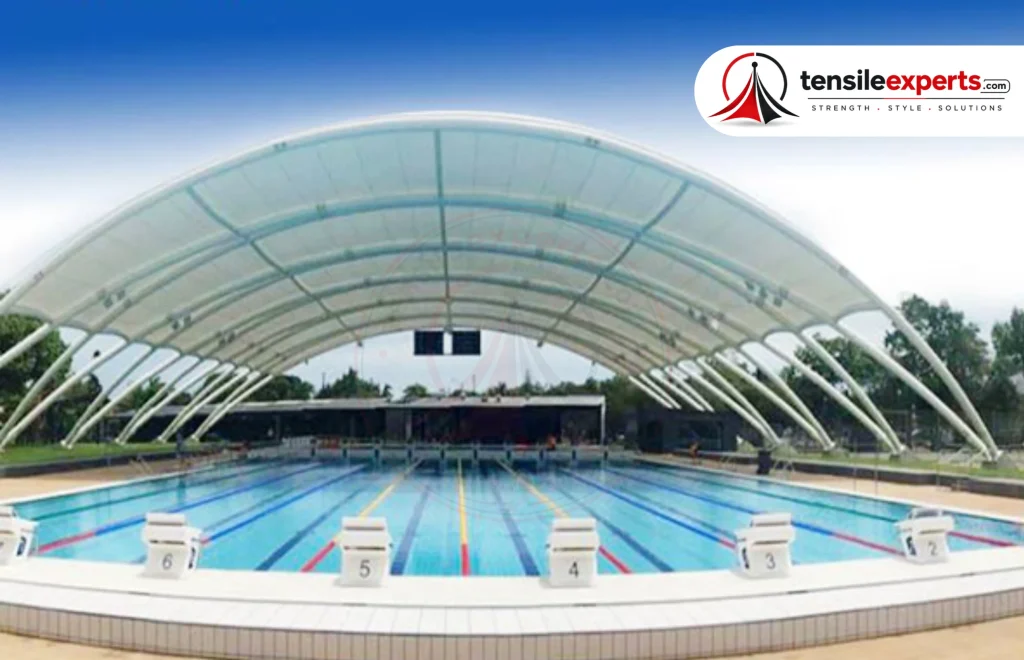
A tensile structure built a few kilometres from the sea faces a genuinely different set of stresses than the same design inland — not because the engineering changes in principle, but because salt-laden air attacks steel in ways dry inland air simply doesn’t. Here’s what actually happens in a coastal environment, and what’s worth asking about before building there.
Why coastal environments are genuinely different
Marine air carries chloride — salt — which is particularly destructive to unprotected steel because it breaks down the thin protective oxide layer that would otherwise slow corrosion, and it doesn’t let that layer easily reform. Combined with the high humidity, salt spray and repeated wetting-and-drying cycles typical of coastal locations, this makes marine environments one of the more aggressive corrosion conditions a structure can face — meaningfully more demanding than an inland site with similar rainfall but without the salt exposure.
What corrodes first?
It’s rarely a large, flat steel member that fails first — corrosion concentrates at specific vulnerable points: welds (where the coating is hardest to apply perfectly evenly), bolt heads and threads, cut edges where raw steel is exposed, and anywhere a coating was scratched or damaged during fabrication, transport or installation. This is exactly why a coastal inspection focuses on these specific points rather than a general glance at the frame — a structure can look fine from a distance while these small, concentrated points are already corroding.
Membrane vs supporting steel
The tensile membrane itself — PVC or PTFE-coated fabric — isn’t meaningfully affected by salt air the way steel is; its durability considerations (UV, cleaning, general weathering) are largely the same near the coast as inland, covered in our PVC vs PTFE comparison. The steel frame, its coatings, and every connection are where coastal exposure actually changes the picture, which is why coastal-specific attention goes toward the structural system, not the fabric choice.
Membrane considerations near the coast
While salt air doesn’t corrode the membrane the way it does steel, coastal sites do add a couple of genuine fabric-side considerations worth knowing about: salt residue can accumulate on the surface between cleanings in the same way dust does inland, so washing frequency benefits from reflecting that; and humidity levels are typically higher near the coast, which is worth factoring into how a fabric’s self-cleaning behaviour (PTFE’s low-friction surface sheds this more easily than PVC does) actually plays out at that specific site. Neither point changes the fundamental material choice — it’s a maintenance-frequency consideration, not a durability one.
Connections and fasteners
Bolted and clamped connections are a particular coastal weak point for a structural reason, not just a coating one — a bolt thread is difficult to fully coat evenly, and the contact point between two different fittings can trap moisture and salt against bare or thinly protected metal. Where practical, connection design for coastal or high-corrosion sites accounts for this — material compatibility between the fastener and the structure it’s connecting (mixing incompatible metals can accelerate corrosion at that specific joint through galvanic action), and detailing that avoids creating a moisture trap at the connection itself.
Protective systems, conceptually
Galvanising — coating steel with a sacrificial zinc layer — is a well-established protection method that corrodes zinc rather than the steel underneath, holding out real protection for far longer than bare steel would last in the same environment. Additional coating systems (paint, epoxy or polyurethane layers) can add a further barrier against moisture and chloride penetration on top of that. The right combination, and the specific coating thickness or grade appropriate for a given structure, is a project-specific engineering decision — it depends on exact distance from the coast, prevailing wind direction, the structure’s exposure, and the client’s maintenance expectations, confirmed by the design team rather than picked from a generic coastal-city rule.
Detailing that avoids water and salt traps
How a connection or a structural detail is shaped matters almost as much as what it’s coated with — a joint or bracket that lets water pool against bare metal will corrode faster than an equally-coated one designed to drain and dry. Good coastal detailing generally avoids horizontal ledges or pockets on exposed steel where salt spray and rainwater can sit, and favours shapes that let moisture run off rather than collect. This is a design-stage consideration, not something fixed after the fact.
Distance and exposure nuance
“Coastal” isn’t a single exposure level — a structure directly facing open sea spray experiences meaningfully harsher conditions than one a few kilometres inland in the same city, and prevailing wind direction can shelter one side of a site while exposing another. This is why “it’s a coastal city, so use the coastal spec” is too blunt a rule to design from — actual distance from the water, direct sea-facing exposure versus a sheltered position, and even the surrounding buildings can all shift how aggressive the real corrosion environment is for a specific structure.
Water traps deserve their own attention
Beyond general detailing, it’s worth calling out water traps specifically: any horizontal surface, pocket or overlap on exposed steel where rain or salt spray can collect and sit — rather than drain away — becomes a concentrated corrosion point regardless of how good the coating is elsewhere on the same member. These are often small, easy-to-miss details (a bracket’s top edge, an overlapping plate) rather than an obvious design flaw, which is why reviewing connection drawings specifically for trapped-water risk is a genuine, worthwhile step in coastal design.
Inspection considerations near the coast
The same inspection areas covered in our maintenance and inspection guide apply near the coast, but the useful frequency is typically higher — corrosion that would take years to become visible inland can progress meaningfully faster under sustained salt exposure, especially at welds, bolts and cut edges. An inspection routine that’s adequate for an inland site may not catch coastal corrosion early enough if applied on the same schedule without adjustment.
Questions owners should ask
For a coastal or near-coastal project, ask:
- What coating/galvanising spec is proposed for my site’s specific exposure?
- Has the design accounted for connection and fastener detailing specifically, not just the main frame?
- Are fasteners and fittings material-compatible with the main structure?
- What inspection frequency is recommended given the coastal exposure?
- Has actual distance from the coast and prevailing wind direction been considered, not just “it’s a coastal city”?
FAQ
Does the tensile membrane itself corrode near the coast?
No — the fabric isn’t meaningfully affected by salt air. Coastal exposure is primarily a steel-frame, connection and fastener consideration, not a membrane one.
Is galvanised steel enough protection for a coastal structure?
Galvanising is a genuine, well-established protection method, but whether it’s sufficient alone or needs an additional coating system depends on the specific site’s exposure and the project’s requirements — confirmed by the design team, not assumed universally.
Does every coastal city need the same specification?
No — exposure varies with actual distance from the coast, prevailing wind, and local conditions, even within the same city. Specification is project-specific, not a blanket coastal-city rule.
How often should a coastal structure be inspected?
Generally more frequently than an equivalent inland structure, since corrosion at welds, bolts and cut edges can progress faster under sustained salt exposure. The exact useful frequency depends on the specific site.
Can mixing different metals in fasteners cause problems near the coast?
Yes — incompatible metal combinations can accelerate corrosion at that specific connection through galvanic action, which is why fastener material compatibility is worth confirming as part of the design.
If you’re planning a project in a coastal or high-humidity location, share your site details so the design and material specification can actually reflect your exposure rather than a generic assumption. For the full project sequence, see Planning a Tensile Structure Project: A Step-by-Step Guide.

