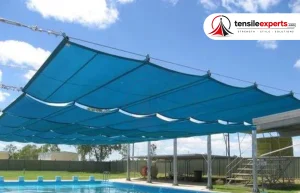
A fixed tensile canopy and a retractable tensile roof solve the same basic problem — shelter from sun and rain — in genuinely different ways, and the right one depends on how the space underneath actually gets used, not just budget. Here’s what actually separates them, and how to tell which one fits your project.
What “fixed” actually means
A fixed tensile structure is a permanently tensioned membrane, engineered and installed to stay in one shape for its working life. It’s the more common form for car parking, entrance canopies, walkways and most architectural roofs — the membrane goes up once, gets tensioned to its final form, and provides continuous, predictable coverage without any moving parts to operate or maintain.
What “retractable” actually means
A retractable tensile structure is designed to open and close — the membrane travels along a track or folds back, exposing the space underneath to open sky when it’s extended out of the way, and providing shelter when deployed. It suits spaces where the ideal state genuinely changes through the day or across seasons: a poolside deck that wants full sun in the morning and shade by afternoon, or an event space that needs to switch between open-air and covered depending on the occasion and the weather.
Fixed vs retractable: full comparison
| Dimension | Fixed structure | Retractable structure |
|---|---|---|
| Coverage | Continuous, always in place | Adjustable — open or closed on demand |
| Design flexibility | Wide range of forms — hypar, conical, multi-peak, cantilever | Constrained by the track/fold mechanism the membrane travels through |
| Mechanical complexity | None — no moving parts | Genuine mechanical system — tracks, rollers or fold points that need upkeep |
| Operation | No operation needed once installed | Manual or motorised operation, depending on the system |
| Maintenance | Membrane, frame and connection checks only | Same checks, plus the mechanical/moving components |
| Weather/wind considerations | Engineered for continuous exposure to full site wind loads | Typically retracted ahead of severe weather; open state has its own wind/engineering limits |
| Structural requirements | Frame and foundation sized for permanent load and full wind exposure | Frame plus a working track/mechanism, both engineered together |
| Installation | Generally more straightforward — no mechanism to commission | More involved — mechanism installation and commissioning add steps |
| Cost factors | Lower upfront cost for a given covered area | Higher upfront cost — mechanism, tracks and (if motorised) controls add to it |
| Use cases | Parking, walkways, entrances, permanent architectural roofs | Pool decks, event spaces, dining areas wanting open-air/covered flexibility |
| Long-term ownership | Simple, predictable — fewer components to eventually service or replace | Mechanism is an added long-term component, alongside the membrane itself |
Benefits and limitations
Fixed — benefits
- No moving parts, nothing to operate or fail mechanically
- Wider range of architectural forms and spans
- Generally lower upfront cost for the same covered area
- Simpler, more predictable long-term maintenance
Fixed — limitations
- No way to open the space to full sky when shelter isn’t wanted
- Membrane is permanently exposed to UV and weather year-round
- Less adaptable to a space whose ideal use genuinely changes
Retractable — benefits
- Genuine flexibility — open or covered, on demand
- Membrane exposure can be limited to when it’s actually deployed
- Suits spaces that need to serve two different uses
Retractable — limitations
- Higher upfront cost — mechanism adds real engineering and expense
- A mechanical system to maintain, alongside the membrane itself
- More constrained design range than a fixed structure’s open forms
- Open state typically has its own, more limited wind-exposure design case
Maintenance differences
A fixed structure’s maintenance is exactly what’s covered in our maintenance and inspection guide — membrane, frame, connections and drainage. A retractable structure needs all of that, plus periodic checks on the track or fold mechanism itself: that it runs smoothly without binding, that rollers or guides aren’t accumulating dirt or corrosion, and that the membrane isn’t developing wear specifically at the points where it contacts the mechanism during operation. This is a genuine, ongoing difference in maintenance scope, not just an installation-time one.
Installation itself reflects this same complexity difference. A fixed structure’s installation ends once the frame is erected and the membrane is tensioned to its final shape — there’s nothing further to commission. A retractable system needs an additional commissioning step after that: the track or fold mechanism has to be tested through its full range of motion, checked for smooth, even operation, and — if motorised — has its controls set up and tested before handover. This adds real time to the installation schedule, worth planning for rather than assuming both systems install in a similar timeframe.
When a fixed structure makes more sense
If the space needs continuous, predictable coverage — a parking area, a walkway, an entrance that always needs shelter — a fixed structure does the job with less cost and less long-term complexity. It’s also the more natural choice when the architectural form itself matters: a large-span, multi-peak or cantilevered roof is generally a fixed-structure design, since a retracting mechanism constrains the shapes it can practically support.
When a retractable structure makes more sense
If the space genuinely needs to alternate — open to the sky for part of the day or year, sheltered for the rest — a retractable system earns its added cost and complexity in a way a fixed structure simply can’t replicate. Poolside decks, rooftop dining, and event or function spaces that host both open-air and weather-protected occasions are the clearest genuine use cases.
Hybrid approaches
The choice isn’t always strictly one or the other across an entire site. A larger project sometimes uses a fixed structure over the areas that genuinely need continuous coverage — a main dining space or a parking zone — and a retractable section over a smaller area meant to flex between open-air and sheltered use, such as an adjoining terrace or lounge. This isn’t a default recommendation, since it adds its own coordination between two different systems on one site, but it’s worth knowing the option exists rather than assuming the whole project has to pick a single approach.
Decision checklist
Before deciding, check:
- Does the space need coverage all the time, or does the ideal state change through the day/season?
- Is a specific architectural form or large span a priority?
- Is the budget able to absorb a retractable mechanism’s added cost?
- Who will operate and maintain a mechanism, if one is added?
- Does the site’s wind exposure suit an open-state design, if retraction is needed regularly?
FAQ
Is a retractable tensile structure always more expensive than a fixed one?
For a comparable covered area, yes — the track/fold mechanism and its engineering add real cost on top of the membrane and frame a fixed structure also needs. Whether that’s worth it depends entirely on whether the flexibility is actually used.
Can a retractable structure handle the same wind loads as a fixed one?
Not necessarily in its open state — retractable systems are typically closed ahead of severe weather, and the deployed/open condition has its own design case that’s usually more limited than a permanently fixed structure’s full-exposure engineering.
Does a retractable structure need more maintenance than a fixed one?
Yes, in scope if not necessarily in frequency — it needs everything a fixed structure needs, plus periodic checks on the mechanism itself (tracks, rollers, guides).
Can a retractable system be motorised?
Retractable systems can be manual or motorised depending on the specific project and mechanism — the right choice depends on scale, frequency of use and budget, confirmed during design rather than assumed upfront.
Which is better for a car parking shed?
A fixed structure, in almost every case — parking needs continuous, predictable coverage rather than the ability to open to sky, which is what a retractable system is actually for.
See our Retractable Tensile Structure page for what we design and install for exactly this kind of project, or if your space needs permanent coverage, explore the full range of tensile structure types we build. For the full sequence of how either option actually gets designed and built, see Planning a Tensile Structure Project: A Step-by-Step Guide, and for the factors that move the price either way, What Determines the Cost of a Tensile Structure in India.